Stacks/Coding agents / developer productivity
Toni Cardoso: a solo founder's home agent team with cross-model review
A practical solo setup: three home machines, OpenBot as the hub, a Hermes agent minding the server, and a strict rule that the agent writing code never reviews it. What broke: memory drift from agents saving dated status (fixed with one fact, one home), too many agents and middlemen (retired), a free-model rate limit that stalled the server agent (no automatic fallback now), and long chats getting sloppy (medium effort and fresh context after each spec). Everything that reaches a real person is drafted for the owner to send.


- Use case
- One person with a full-time job runs the day-to-day work on a few side products with a team of agents on home hardware: product-owner agents build in each repo, a security reviewer approves every change, a chief-of-staff agent hands out work and merges, and a main agent keeps the home server healthy.
- Category
- Coding agents / developer productivity
- Team size
- 1 person
- Orchestrator / framework
- OpenBot runs 24/7 on a home server as the hub, run by a Chief of Staff agent (Zarco) that assigns work, manages GitHub and merges after owner approval. A Hermes agent (Rook) is the main agent and home server operator, connected to OpenBot through a custom gateway. Builders use Claude Sonnet 5.5 and DeepSeek V4.1 Flash; code review runs on GPT-6 Luna and the security reviewer on Gemini 4 Argon, so a different model family checks every PR. Flow: spec, small tickets, one ticket per fresh run in its own git worktree. Two-way-door changes merge after checks, review and security approval; one-way-door changes (migrations, login, billing, pipeline, anything sent to people) and every production release wait for the owner.
- Memory
- One shared Obsidian vault holds a rules file every agent reads first, plus decisions; agent memory holds only pointers and live status is checked every time. A shared memory service was switched off after it became a second source of truth.
- Evals
- A model only changes after a live test with the real tools for that job.
- Other tools
- ObsidianGit worktreesDockerGitHub
- Source
- https://x.com/ToniRMCardoso/status/2125353801586442527
Toni Cardoso (@ToniRMCardoso) · Published Nov 24, 2026 · Last verified Nov 26, 2026
Related
More like this
 openai.com
iFood Remote Agents Platform: coding agents as an API across 15,000 repos
An internal REST API that launches remote coding-agent tasks across iFood's 15,000+ repositories (standards checks, vulnerable dependency fixes, analyses) and returns a merge request. Its first major user is iFood's security platform, which scans repositories for vulnerable dependencies and fixes them.
Stated: US$0.04 per run

 infoq.com
OpenAI ChatGPT Ads: a product built entirely by Codex agents
A small group of engineers used Codex coding agents to build OpenAI's ChatGPT Ads product with zero human-written code, reaching $100M annualized revenue within six weeks of launch.
 uber.com
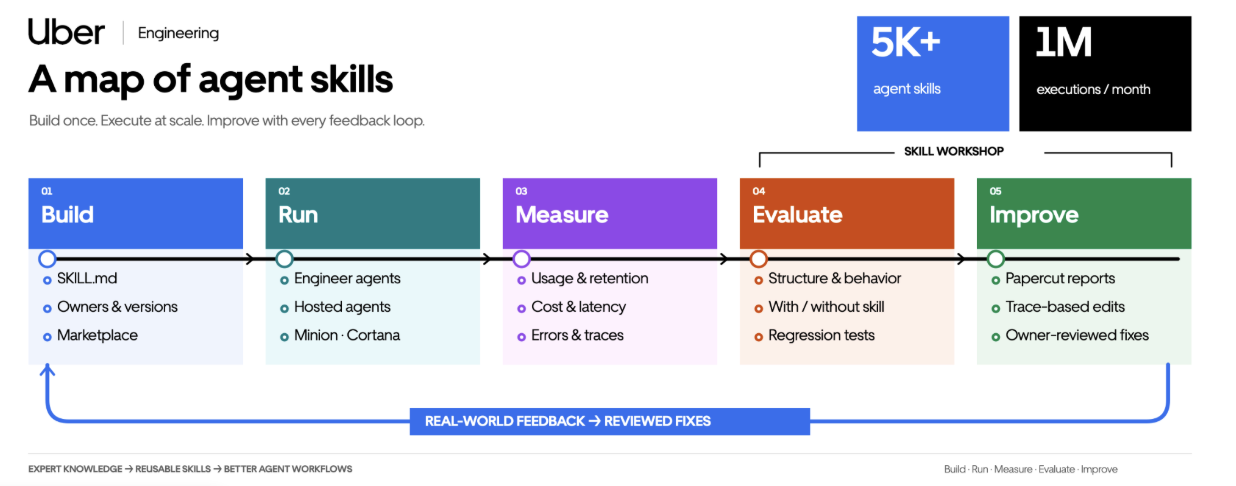
Uber skills marketplace: evaluating 1M+ agent skill invocations a month
A company-wide marketplace of agent skills (Markdown workflows such as opening a pull request, querying the metrics warehouse, root-cause analysis, or answering merchant support questions) used by Uber's background agents, sandboxes, and engineers' coding agents. It grew from 1 skill in October 2025 to more than 5,000, with more than 1 million invocations in a month.