Stacks/Coding agents / developer productivity
OpenAI ChatGPT Ads: a product built entirely by Codex agents
At QCon San Francisco 2026, OpenAI's Brian Yang described building ChatGPT Ads entirely with Codex, reaching $100M ARR in six weeks and $1B in under 200 days. The system that builds the product does the work: parallel agent threads, bundled candidate PRs, tiered sandboxes with shadow traffic, and a target of about 90% auto-approval for everyday PRs. Failure modes he named include slop when output goes unchecked, agents over-writing tests, and an agent that deleted and re-provisioned Kubernetes pods without asking. Reported by InfoQ (Daniel Curtis).


- Use case
- A small group of engineers used Codex coding agents to build OpenAI's ChatGPT Ads product with zero human-written code, reaching $100M annualized revenue within six weeks of launch.
- Category
- Coding agents / developer productivity
- Team size
- a small group of engineers
- Orchestrator / framework
- Engineers act as managers of agents: about ten minutes of voice-mode intake where Codex interviews the engineer for requirements, then a spec handed to multiple agents. An orchestrator thread spawns five sub-threads to explore approaches in parallel and the best result is picked. Thirty to forty candidate changes are bundled into one PR and run together for a day or two before human review. Maintenance agents run beside feature agents to root-cause new log patterns. Destructive actions need authorized roles and deployments need physical confirmation.
- Evals
- Every change runs local and unit tests; complex changes get end-to-end user journeys via browser automation; the most critical run in production-like sandboxes with representative traffic (read-only, write-only with telemetry suppressed, or full fidelity with shadow-tagged telemetry). Latency studies gate candidate PRs on P50 and P95 time-to-first-ad with guardrails on ads returned, timeouts and error rates. The team reviews the past 300 to 400 PRs weekly to backtest reviewer thresholds, and the 50 slowest tests weekly.
- Observability
- Shadow-tagged telemetry from sandboxes is filtered out downstream; maintenance agents watch for newly appearing log patterns.
- Reliability (as stated)
- around 90%Target
Auto-approval of everyday PRs · as of QCon San Francisco 2026
“Yang's team targets around 90% auto-approval of everyday PRs, reviewing the past 300 to 400 PRs weekly and backtesting reviewer thresholds against that rate.” Source
As stated in the source, checked 2026-11-26. Never a WhatWeRun estimate. Eval, benchmark, and target figures are not production results.
- Models
- Other tools
- Browser automation for end-to-end testsProduction-like sandboxes
- Source
- https://www.infoq.com/news/2026/11/qcon-sf-openai-lessons/
Brian Yang (OpenAI), QCon San Francisco 2026; InfoQ writeup by Daniel Curtis · Published Nov 24, 2026 · Last verified Nov 26, 2026
Related
More like this
 openai.com
iFood Remote Agents Platform: coding agents as an API across 15,000 repos
An internal REST API that launches remote coding-agent tasks across iFood's 15,000+ repositories (standards checks, vulnerable dependency fixes, analyses) and returns a merge request. Its first major user is iFood's security platform, which scans repositories for vulnerable dependencies and fixes them.
Stated: US$0.04 per run

 x.com
Toni Cardoso: a solo founder's home agent team with cross-model review
One person with a full-time job runs the day-to-day work on a few side products with a team of agents on home hardware: product-owner agents build in each repo, a security reviewer approves every change, a chief-of-staff agent hands out work and merges, and a main agent keeps the home server healthy.
 uber.com
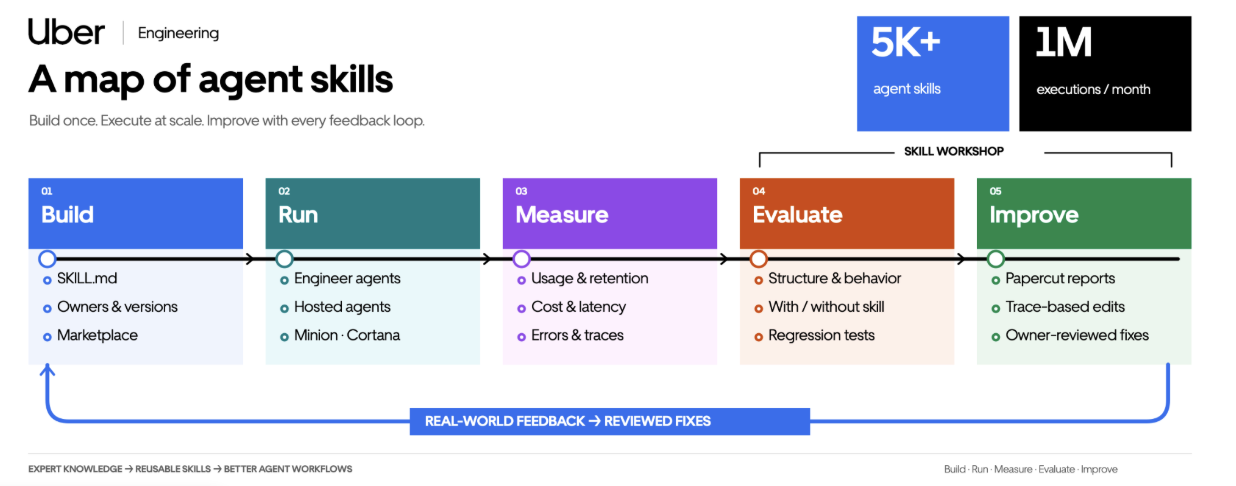
Uber skills marketplace: evaluating 1M+ agent skill invocations a month
A company-wide marketplace of agent skills (Markdown workflows such as opening a pull request, querying the metrics warehouse, root-cause analysis, or answering merchant support questions) used by Uber's background agents, sandboxes, and engineers' coding agents. It grew from 1 skill in October 2025 to more than 5,000, with more than 1 million invocations in a month.