Stacks/Coding agents / developer productivity
Uber skills marketplace: evaluating 1M+ agent skill invocations a month
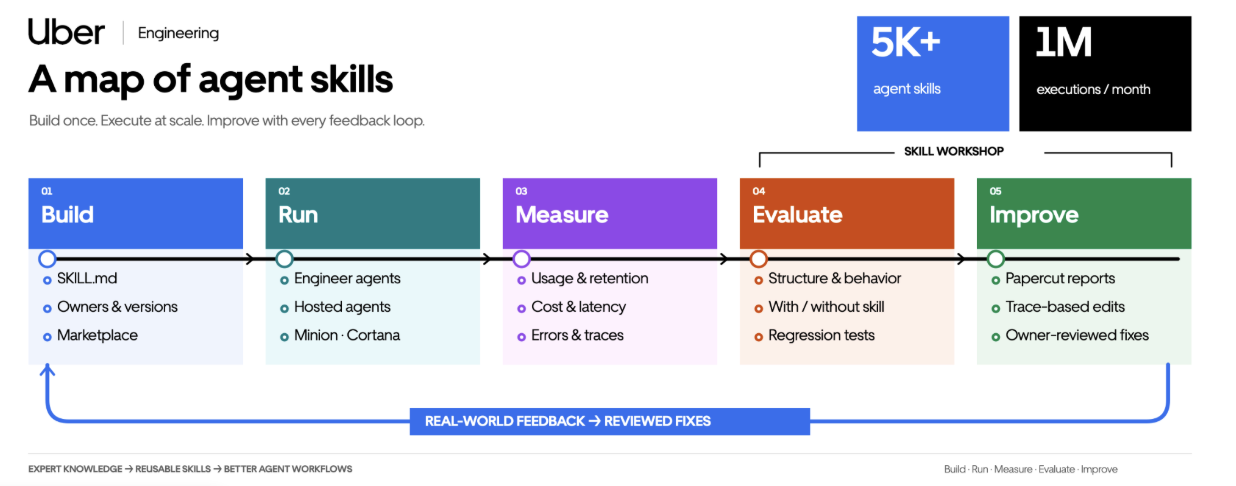
Uber treats agent skills as owned software with KPIs. Every skill lives in one repo and runs the same in Claude Code, Codex, OpenCode, Cursor and Uber's hosted agents through aifx. Evals mix golden cases, trajectory-graded real prompts and author cases, and ablations check whether a skill actually helps: the warehouse-query skill won 87% of blind comparisons, and sessions without it took 31% longer with six times the tool errors. Moving a tracing skill to a cheaper-model worker cut its cost per invocation 46%. Agents file their own bug reports (papercuts), and hundreds have been fixed.

- Use case
- A company-wide marketplace of agent skills (Markdown workflows such as opening a pull request, querying the metrics warehouse, root-cause analysis, or answering merchant support questions) used by Uber's background agents, sandboxes, and engineers' coding agents. It grew from 1 skill in October 2025 to more than 5,000, with more than 1 million invocations in a month.
- Category
- Coding agents / developer productivity
- Orchestrator / framework
- Skills load in stages (name and description always, body when run). aifx, an internal command-line tool, gives every agent surface the same sign-in, skills, and MCP connections, merging config in layers (company, team, repo, directory, user). Skills run on Minion (background agent platform), AES (managed agent sandbox), and devpods. Cost levers: deterministic steps run as code through a tool gateway (Code Mode) instead of loading MCP tool definitions; skills dispatch a worker subagent on a cheaper model and return a bounded summary; scripts run at skill load; PR polling moved to a background agent on a cheaper model. Tiers: domain, core, and about 100 always-on skills.
- Evals
- Suites are about 5% golden cases with fixed input, expected output and tool mocks, 80% real prompts graded on trajectory, and 15% author-created cases, run in three environments (Minion, AES, devpods). LLM-as-judge backed by human-annotated sets; trajectory evals check whether the agent used the right skills and tools in order. Ablations replay real prompts with and without a skill (or parts of it) and a blind judge picks the better answer. Blocked or reworked PRs from the Fawkes maintenance factory become eval cases.
- Observability
- Telemetry events from agent hooks compute 12 measures per skill (users, retention, cost, latency, errors, among others), shown in Skill Workshop. Per-invocation cost comes from the difference in a session's running cost total before and after a skill call. An always-on log-papercut skill lets agents file structured friction and bug reports to one dashboard grouped by skill; thousands were filed in three months.
- Reliability (as stated)
- 87%Eval
Blind comparisons won by answers using the warehouse-query skill (ablation) · ablation test reported November 2026
“In our ablation test of a skill that runs warehouse queries, sessions without the skill made 13% more tool calls, had six times as many tool errors, and took 31% longer, and the answer with the skill won 87% of the comparisons.” Source
As stated in the source, checked 2026-11-26. Never a WhatWeRun estimate. Eval, benchmark, and target figures are not production results.
- Other tools
- aifxSkill WorkshopMinionAES sandboxDevpodsTool gateway (Code Mode)Fawkes
- Source
- https://www.uber.com/gb/en/blog/optimizing-ubers-agent-skills/
Andrew Mager, Jason Varbedain, Uday Kiran Medisetty (Uber Engineering, @UberEng) · Published Nov 23, 2026 · Last verified Nov 26, 2026
Related
More like this
 openai.com
iFood Remote Agents Platform: coding agents as an API across 15,000 repos
An internal REST API that launches remote coding-agent tasks across iFood's 15,000+ repositories (standards checks, vulnerable dependency fixes, analyses) and returns a merge request. Its first major user is iFood's security platform, which scans repositories for vulnerable dependencies and fixes them.
Stated: US$0.04 per run

 infoq.com
OpenAI ChatGPT Ads: a product built entirely by Codex agents
A small group of engineers used Codex coding agents to build OpenAI's ChatGPT Ads product with zero human-written code, reaching $100M annualized revenue within six weeks of launch.

 x.com
Toni Cardoso: a solo founder's home agent team with cross-model review
One person with a full-time job runs the day-to-day work on a few side products with a team of agents on home hardware: product-owner agents build in each repo, a security reviewer approves every change, a chief-of-staff agent hands out work and merges, and a main agent keeps the home server healthy.