Stacks/Coding agent
Corezoid's ticket-routing coding agent
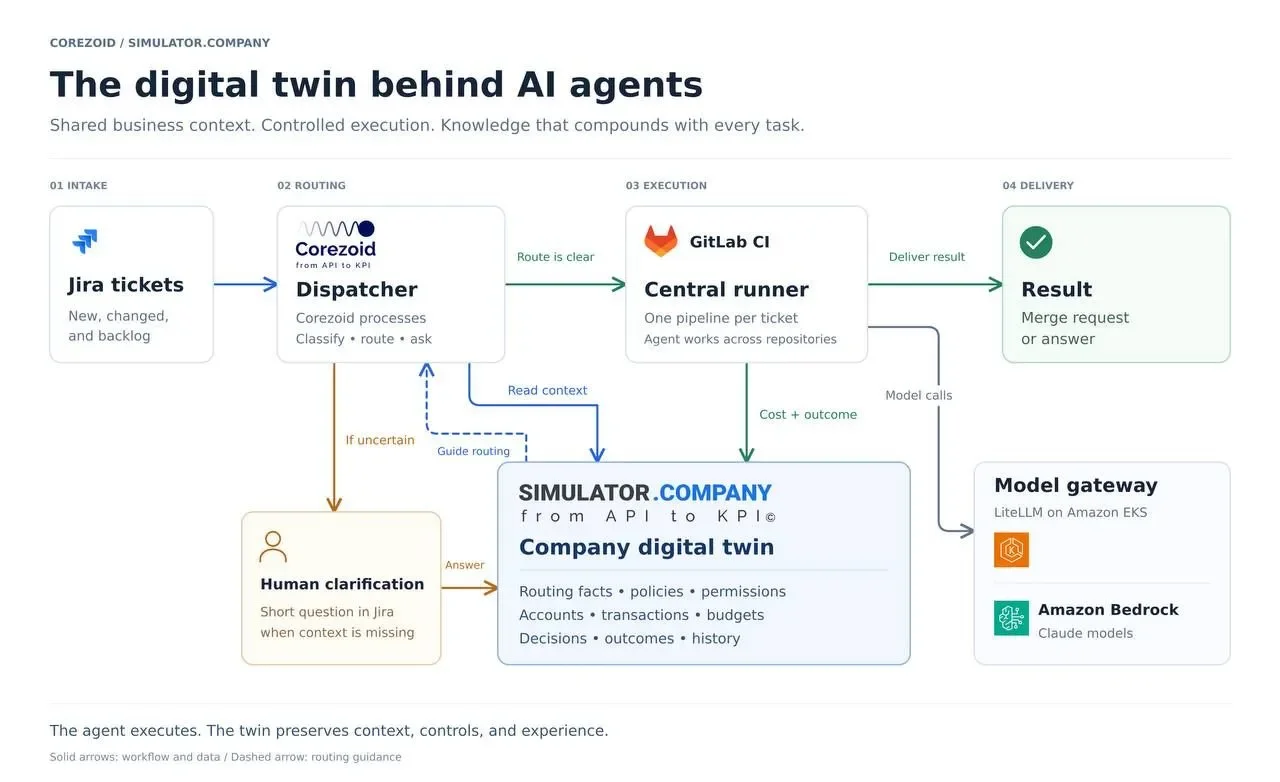
Corezoid found routing tickets harder than writing code, so it built a digital twin of its engineering org that tells a Jira-triggered coding agent where work belongs, plus model choices, budgets, and limits. Claude Sonnet, Opus, and Haiku run through Amazon Bedrock and a LiteLLM gateway, and cost per code change fell from about $10 to about $2.50. Written with an AWS solutions architect.

- Use case
- A coding agent triggered by Jira labels that fixes tickets and opens merge requests, with a digital twin of the engineering org deciding which repository, process, or service each ticket belongs to
- Category
- Coding agent
- Team size
- not stated
- Orchestrator / framework
- A Jira label triggers a pipeline that runs the coding agent. A digital twin in Simulator.Company stores about 600 routing facts for 211 targets (each with a source and confidence score), model choices, budgets, and limits; when routing confidence is low the agent asks a person instead of guessing. Limits apply per ticket, project, spend, and retries; jobs moved from a shared GitLab runner to Kubernetes.
- Memory
- The digital twin is the agent's persistent context: routing facts with confidence scores (human-confirmed facts outrank inferred ones), rules, limits, and run history.
- Evals
- Outcomes are tracked per run: from May through October 2026 the agent opened 133 merge requests for 116 tickets in 15 repositories, and 91% of the tickets it completed ended in a merge. Human reviewers catch regressions.
- Observability
- Each run's cost is recorded by ticket, project, repository, and model, alongside decisions, outcomes, and human corrections.
- Cost (stated in writeup)
- First code runs on Claude Opus averaged about $10; after moving ordinary work to Sonnet through the Bedrock gateway, an early code change averaged about $2.50 · per task
- Cost per output (stated)
- Stated: ~$2.50 per code changeDown from about $10 when runs used Claude Opus directly
“The first code runs used Claude Opus directly and averaged about $10. After ordinary work moved to Sonnet through the Bedrock gateway, an early code change averaged about $2.50.”
Stated: ~12¢ per answer run (code inspected, nothing changed)“The agent can inspect the relevant code and reply without changing anything for about twelve cents per run.”
As stated in the writeup, checked 2026-11-13. Separate from the WhatWeRun estimate below.
- WhatWeRun estimate
WhatWeRun estimate
Not enough info to estimate
The writeup states cost per code change (shown above), so there's nothing to estimate. The stated cost stands.
Reviewed Nov 13, 2026
- Models
- Observability tools
- not stated
- Other tools
- Amazon BedrockJiraGitLabKubernetes
- Source
- https://corezoid.com/blog/digital-twin-context-ai-agent-part-1/
Dmitry Makarichev (CTO, Corezoid) and Max Ivashchenko (AWS) · Published Nov 11, 2026 · Last verified Nov 13, 2026
Related
More like this
 aboutamazon.com
The agent teams that build AWS Emulator
Autonomous agents that write, test, and fix every line of AWS Emulator, a downloadable local emulator of AWS services, with no human-written or human-reviewed code

 blog.duolingo.com
Duolingo AI STR Fix bug agent
Investigating and fixing Shake-to-Report bug tickets: gathering context (relevant code, tracking events, experiment states, recent PRs, repro steps) and proposing a fix for engineers to verify

 lovable.dev
Lovable's app-building agent
Chat-driven creation, hosting, and iteration of web apps for people who can't code; users have created more than 70 million projects